



IRAN NEWS BULLETIN
No. 41 | 12–17 November 2026
[This bulletin documents only the most significant acts of persecution and human rights abuses which the BIC has noted during the reporting period. It does not include those routine acts of discrimination to which Bahá’ís in Iran, whether as individuals or as a community, are subjected on a daily basis. The information presented in each bulletin is based on information available at the time of writing and may have changed subsequently.]
1. Mobin Hoseini Arrested After Answering Prosecutor’s Summons in Sari
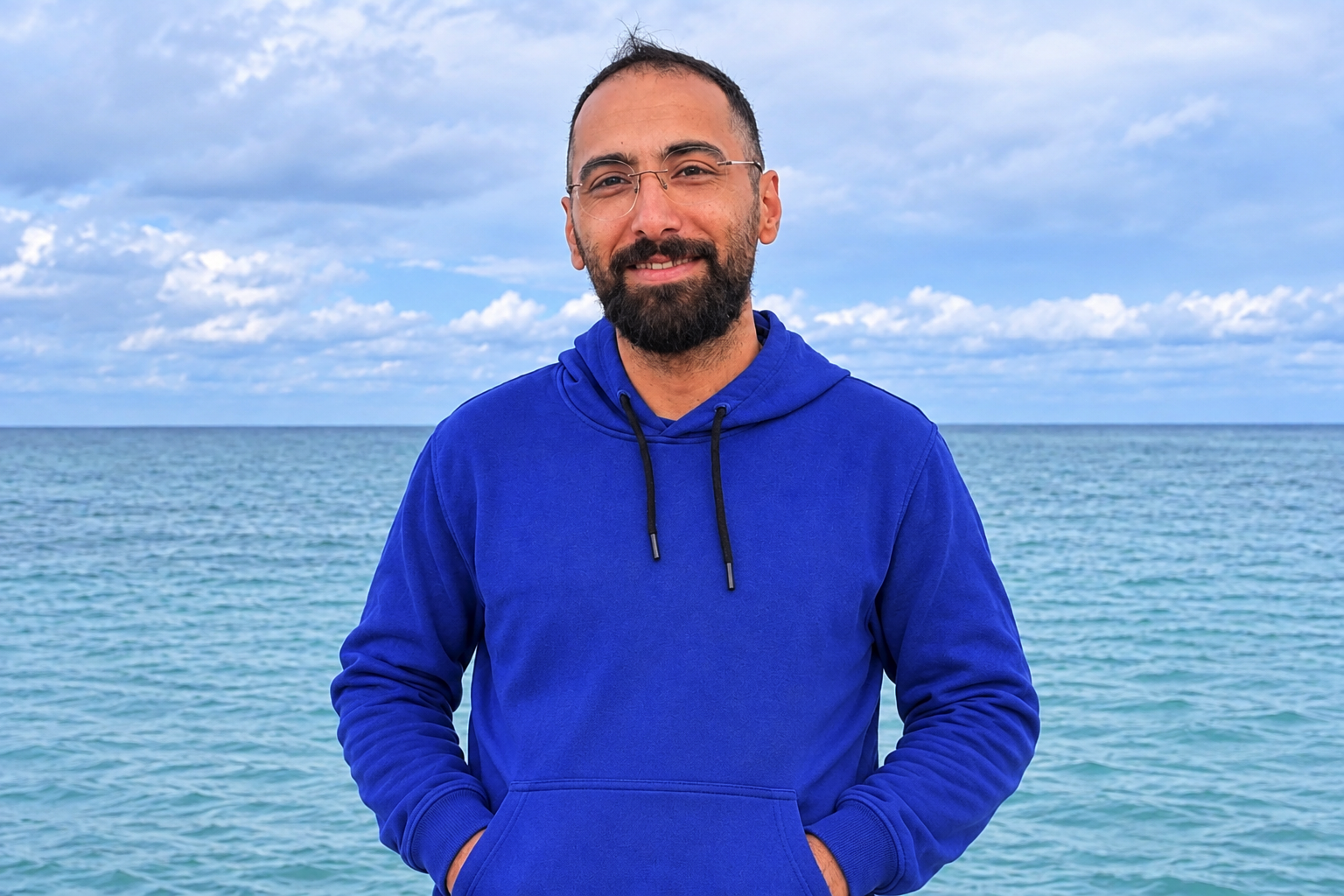
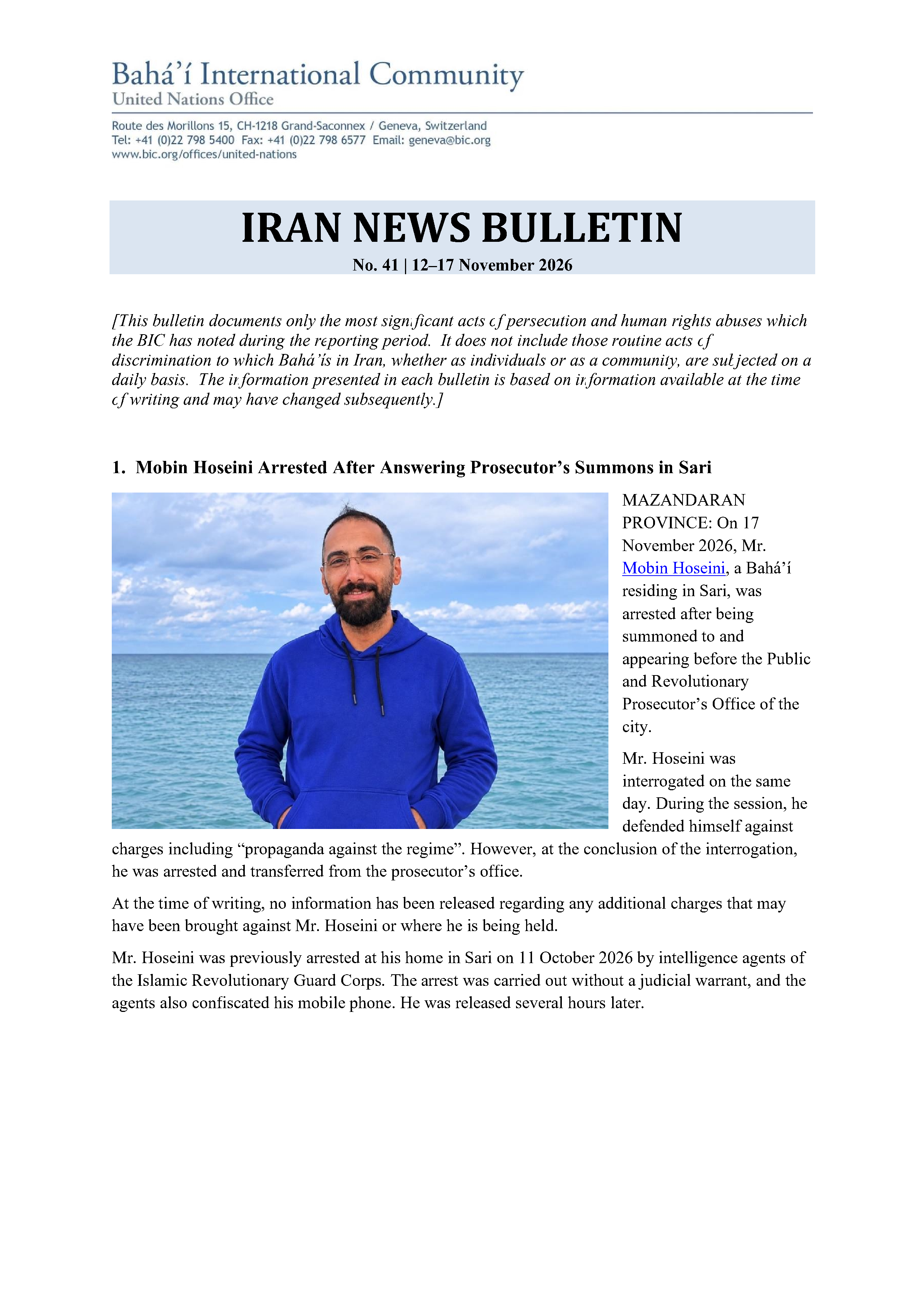
MAZANDARAN PROVINCE: On 17 November 2026, Mr. Mobin Hoseini, a Bahá’í residing in Sari, was arrested after being summoned to and appearing before the Public and Revolutionary Prosecutor’s Office of the city.
Mr. Hoseini was interrogated on the same day. During the session, he defended himself against charges including “propaganda against the regime”. However, at the conclusion of the interrogation, he was arrested and transferred from the prosecutor’s office.
At the time of writing, no information has been released regarding any additional charges that may have been brought against Mr. Hoseini or where he is being held.
Mr. Hoseini was previously arrested at his home in Sari on 11 October 2026 by intelligence agents of the Islamic Revolutionary Guard Corps. The arrest was carried out without a judicial warrant, and the agents also confiscated his mobile phone. He was released several hours later.
2. Intelligence Agents Raid Five Bahá’í Homes in Semnan, Violently Arrest Behfar Khanjani
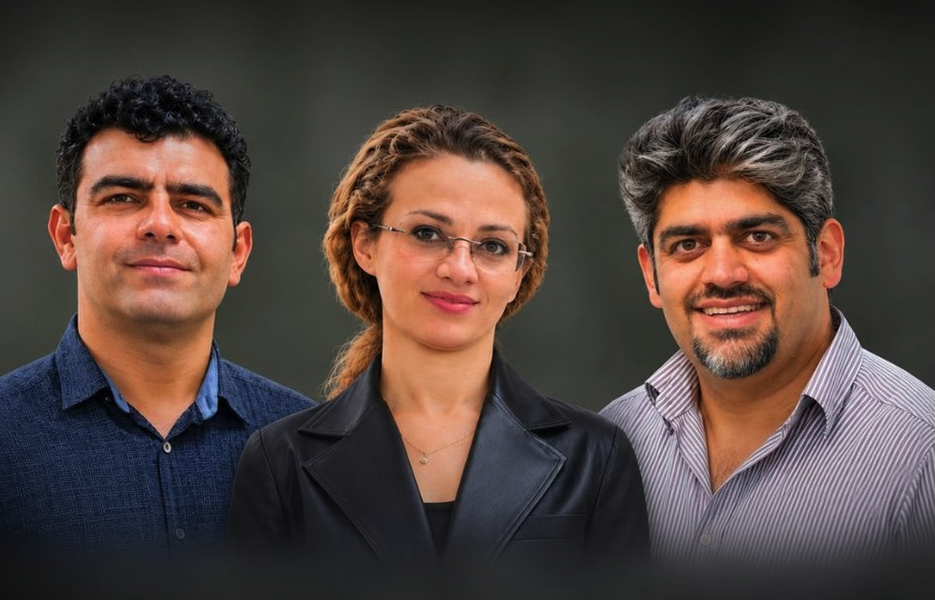
SEMNAN PROVINCE: On 15 November 2026, Intelligence Office agents simultaneously raided the homes of five Bahá’í families in Semnan and confiscated a number of personal belongings, electronic devices, and items related to the Bahá’í Faith. During the operation, Mr. Behfar Khanjani, Mr. Hesam Tebyanian, and Mrs. Zohreh Nik-Aien were arrested.
At about 9:00 a.m., the agents stopped Mr. Khanjani’s car on a street in Semnan and handcuffed him behind his back, which placed him under severe strain because of his psoriasis and joint problems. The agents struck him on the head, took his house key by force, and entered his home a considerable time before bringing him there.
Mr. Khanjani’s daughter was alone at home when the agents entered. She thought at first that her father had returned, but when the door opened she was confronted by four male agents and a masked female agent. Severely frightened, she objected and was beaten: the agents twisted her arm behind her back, and four of them forcibly handcuffed her. She remained alone with the agents while they searched the home, until they brought Mr. Khanjani in, handcuffed. As a result of the stress and the beating, her condition deteriorated so severely that the agents themselves called emergency services, and the family had to take her to hospital that night.
In total, 15 agents searched the home from 9:00 a.m. until 3:00 p.m. The family was not permitted to read the warrant in full. In addition to the residence, the agents searched an unoccupied floor of the building, the storage rooms, and the family’s car. They confiscated all of the family’s Bahá’í books, photographs related to the Bahá’í Faith, documents, the laptop computers belonging to all members of the family, and the mobile telephones of Mr. Khanjani and his wife.
This was the third time Intelligence agents had raided Mr. Khanjani’s home. He had previously been imprisoned in Semnan Prison for four years, beginning in 2011, when his daughters were 8 and 11 years old.
Mr. Khanjani suffers from extensive psoriasis that affects his joints, and he has a growing mass in his liver that urgently requires treatment. For several years, he has also suffered from cardiac arrhythmia, kidney stones, narrowing of the ureter, and digestive problems.
At the same time, the agents searched the home of Mr. Tebyanian and his wife, Mrs. Nik-Aien, and arrested them both. They confiscated the couple’s mobile telephones and a laptop computer, and also searched Mr. Tebyanian’s place of business and his mother’s home.
Separately, agents stopped Mrs. Lida Pirasteh while she was driving in the city and, after presenting a search warrant, accompanied her to her home. They then searched the residence she shares with her husband, Mr. Badi Nowbakht, and confiscated the mobile telephones and laptop computers belonging to members of the family. Mrs. Pirasteh was also summoned to appear at the Intelligence Office.
On the same day, agents raided and searched the home of Mr. Babak Shobeirian and Mrs. Parvaneh Shobeirian. The judicial warrant presented for the search had been issued in the name of Mrs. Shobeirian. The agents informed the family that they would be summoned for questioning at a future date.
During the searches, the agents confiscated books, photographs, and jewellery associated with the Bahá’í Faith, in addition to personal belongings and electronic equipment. Satellite television receivers were also seized from some of the homes.
3. Appeals Court Upholds Arman Misaghian’s Two-Year Prison Sentence and Supplementary Punishments
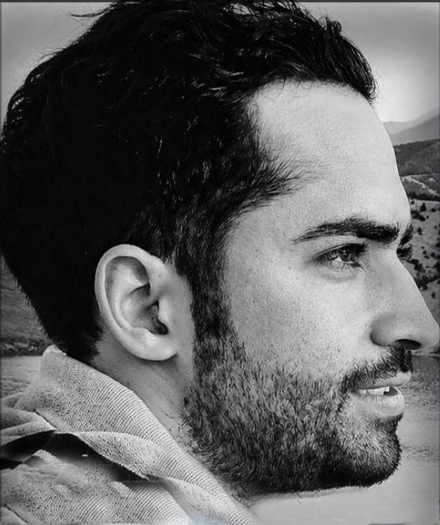
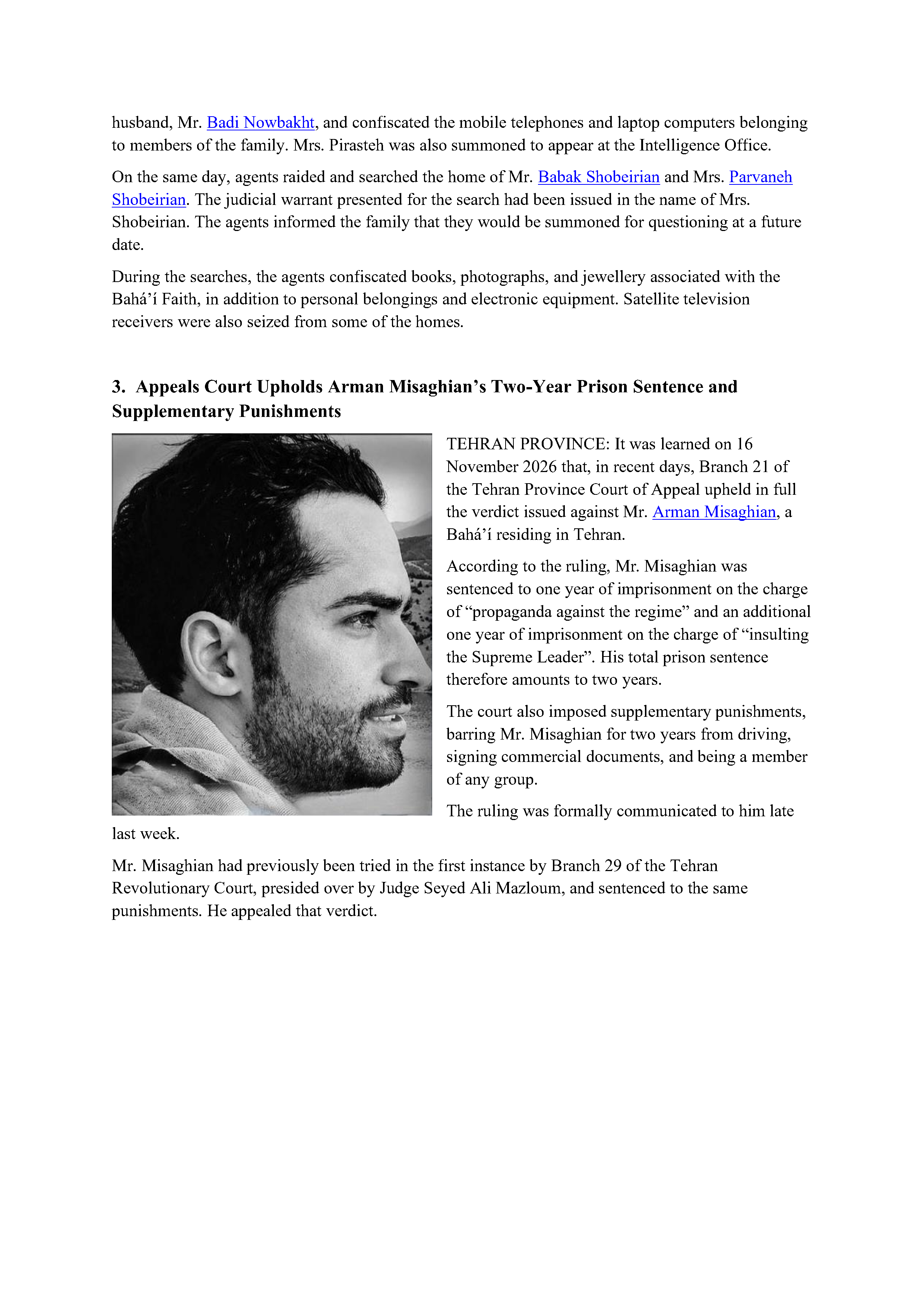
TEHRAN PROVINCE: It was learned on 16 November 2026 that, in recent days, Branch 21 of the Tehran Province Court of Appeal upheld in full the verdict issued against Mr. Arman Misaghian, a Bahá’í residing in Tehran.
According to the ruling, Mr. Misaghian was sentenced to one year of imprisonment on the charge of “propaganda against the regime” and an additional one year of imprisonment on the charge of “insulting the Supreme Leader”. His total prison sentence therefore amounts to two years.
The court also imposed supplementary punishments, barring Mr. Misaghian for two years from driving, signing commercial documents, and being a member of any group.
The ruling was formally communicated to him late last week.
Mr. Misaghian had previously been tried in the first instance by Branch 29 of the Tehran Revolutionary Court, presided over by Judge Seyed Ali Mazloum, and sentenced to the same punishments. He appealed that verdict.
4. Nazanin Abedini Sentenced to Three Years in Prison and Eight Years’ Deprivation of Social Rights
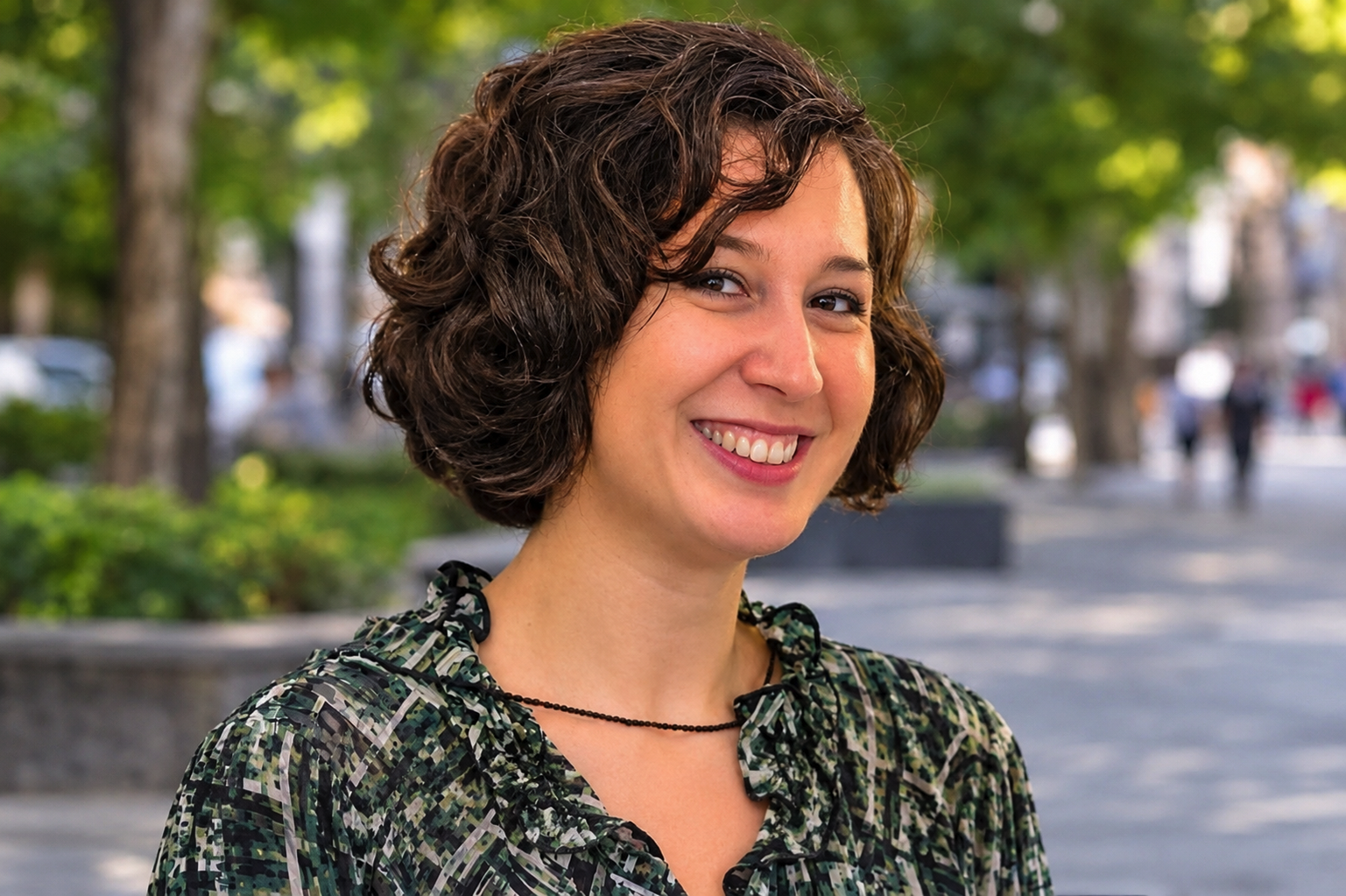
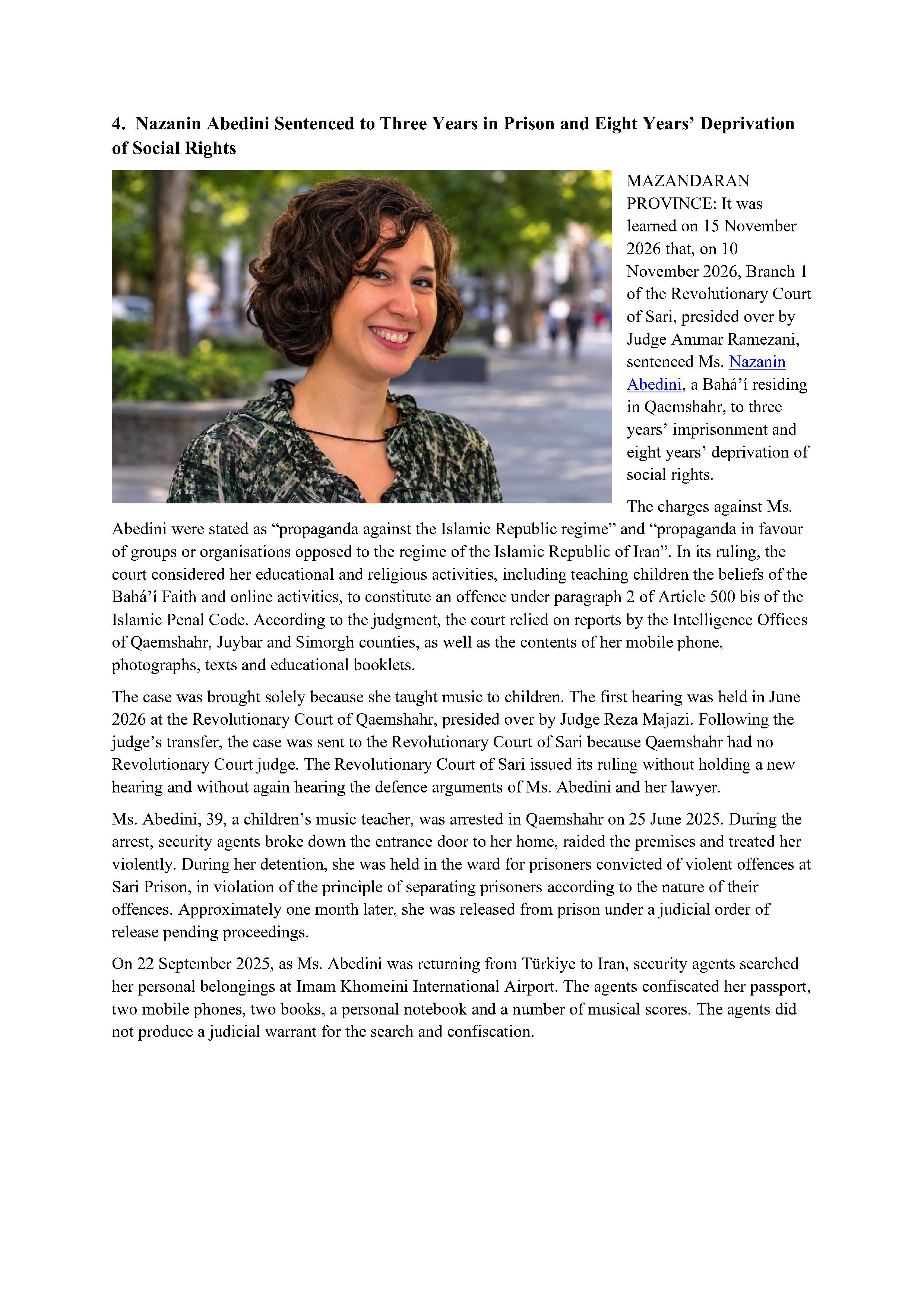
MAZANDARAN PROVINCE: It was learned on 15 November 2026 that, on 10 November 2026, Branch 1 of the Revolutionary Court of Sari, presided over by Judge Ammar Ramezani, sentenced Ms. Nazanin Abedini, a Bahá’í residing in Qaemshahr, to three years’ imprisonment and eight years’ deprivation of social rights.
The charges against Ms. Abedini were stated as “propaganda against the Islamic Republic regime” and “propaganda in favour of groups or organisations opposed to the regime of the Islamic Republic of Iran”. In its ruling, the court considered her educational and religious activities, including teaching children the beliefs of the Bahá’í Faith and online activities, to constitute an offence under paragraph 2 of Article 500 bis of the Islamic Penal Code. According to the judgment, the court relied on reports by the Intelligence Offices of Qaemshahr, Juybar and Simorgh counties, as well as the contents of her mobile phone, photographs, texts and educational booklets.
The case was brought solely because she taught music to children. The first hearing was held in June 2026 at the Revolutionary Court of Qaemshahr, presided over by Judge Reza Majazi. Following the judge’s transfer, the case was sent to the Revolutionary Court of Sari because Qaemshahr had no Revolutionary Court judge. The Revolutionary Court of Sari issued its ruling without holding a new hearing and without again hearing the defence arguments of Ms. Abedini and her lawyer.
Ms. Abedini, 39, a children’s music teacher, was arrested in Qaemshahr on 25 June 2025. During the arrest, security agents broke down the entrance door to her home, raided the premises and treated her violently. During her detention, she was held in the ward for prisoners convicted of violent offences at Sari Prison, in violation of the principle of separating prisoners according to the nature of their offences. Approximately one month later, she was released from prison under a judicial order of release pending proceedings.
On 22 September 2025, as Ms. Abedini was returning from Türkiye to Iran, security agents searched her personal belongings at Imam Khomeini International Airport. The agents confiscated her passport, two mobile phones, two books, a personal notebook and a number of musical scores. The agents did not produce a judicial warrant for the search and confiscation.
5. Bahá’í Couple Arrested in Semnan, Leaving Two Children Without Parents
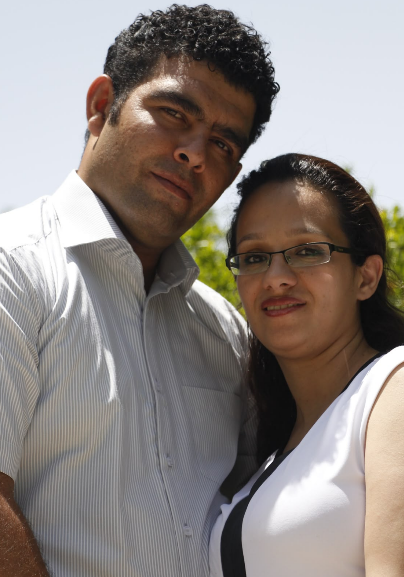
SEMNAN PROVINCE: On 15 November 2026, agents of the Semnan Intelligence Office arrested Mrs. Zohreh Nik-Aien and her husband, Mr. Hesam Tebyanian, two Bahá’ís living in Semnan. The agents raided and searched the couple’s home and confiscated their electronic devices, books and mobile phones.
On the same day, agents also raided and searched the home of Mr. Tebyanian’s mother, as well as his place of business.
Mrs. Nik-Aien had previously been imprisoned because of her religious beliefs. She was arrested in Semnan in March 2011 with several other Bahá’ís and was subjected to interrogation and pressure for nearly a month. She was then sentenced to seven years’ imprisonment, which the appeals court later reduced.
In 2012, Mrs. Nik-Aien went to prison to serve her sentence. Her son, Rasam, was only five months old at the time; he went to prison with her and stayed there until he was two. Poor prison conditions harmed his health, and he developed a severe ear infection and was taken to hospital. Mrs. Nik-Aien was released from Semnan Prison when her sentence ended.
Mrs. Nik-Aien and Mr. Tebyanian are now both in detention. Their two children, a 14-year-old son and a 10-year-old daughter, do not know where their parents are being held or when they will be able to see them again.
6. Hamadan Prosecutor Opposes Conditional Release of Six Bahá’í Prisoners, Suspends Prison Leave
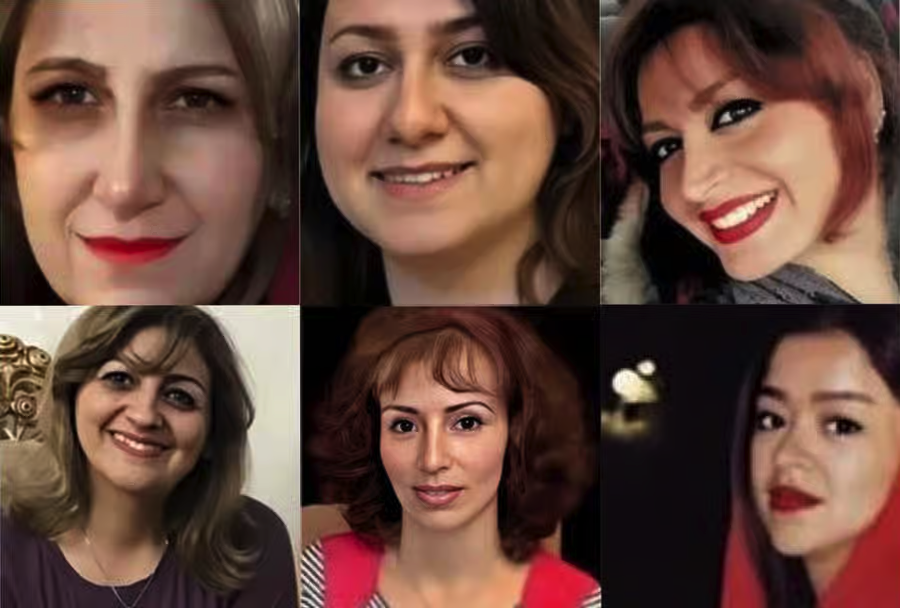
HAMADAN PROVINCE: It was learned on 2 November 2026 that the prosecutor had opposed the request for the conditional release of six Bahá’í prisoners in Hamadan Prison and that their prison leave had also been suspended.
The six Bahá’í prisoners had submitted a written request for conditional release. In opposing it, the prosecutor reprimanded prison officials for allowing the Bahá’ís to write a letter and submit the request.
Until then, the Bahá’í prisoners in Hamadan had taken prison leave in turn, so that one of them was outside prison at any given time; this arrangement was recently discontinued.
Ms. Jaleh Rezaie, one of the Bahá’í prisoners in Hamadan, has a heart condition. During her most recent period of prison leave, she underwent balloon angioplasty of the coronary arteries, was hospitalised for a period and then returned to prison. Ms. Zarrindokht Ahadzadeh also had cancer before her imprisonment and had been continuing her treatment during periods of prison leave.
With the suspension of prison leave, these prisoners’ ability to continue receiving medical treatment outside prison has been restricted.
7. Further Details Emerge on Belongings Confiscated in Raids on Three Bahá’í Homes
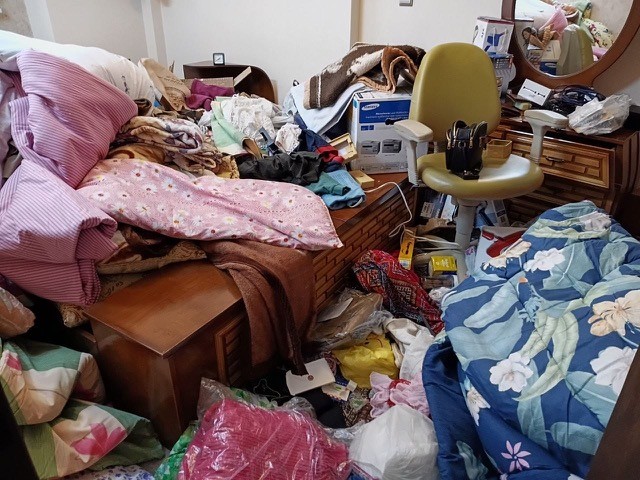
ISFAHAN PROVINCE: Further details emerged on 9 November 2026 regarding the 27 October raids on the homes of Mr. Raouf Rowhani Najafabadi, his mother, Mrs. Ferdows Ferdowsian, and his mother-in-law, Mrs. Forough Darab.
The search warrants had been issued in the names of Mr. Rowhani and his 19-year-old daughter, Ms. Donya Rowhani Najafabadi.
Among the additional items confiscated from Mr. Rowhani’s home were approximately 100 Bahá’í books and pamphlets, around 50 other books, framed Bahá’í photographs and other items, two power banks, a modem, a hand drum, a santur, a guitar, a substantial quantity of stationery, toys and puzzles, three briefcases, and approximately 20 million tomans in cash. The agents also took an ivory-coloured jewellery set comprising a necklace, bracelet and ring, as well as silverware.
From Mrs. Darab’s home, the agents additionally confiscated two gramophones, a radio-cassette player, Bahá’í books and pamphlets, approximately 1.35 million tomans in cash, a large quantity of metal coins, five framed items, plates bearing the Bahá’í symbols, and photo albums.
From Mrs. Ferdowsian’s home, the agents took a DVD player, a gold chain and a necklace bearing the Bahá’í symbols, which they removed from her neck, as well as a ring bearing the same symbols, which they forcibly removed from her finger. They also confiscated porcelain plates and a teapot decorated with these symbols, along with framed Bahá’í photographs and other items.
During the operation, the agents told Mr. Rowhani and his daughter that they were under surveillance and that the authorities knew whom they met with and whom they were in contact with.
Several days before the raid, Mrs. Taraneh Khosravani, Mr. Rowhani’s wife, and her sister, Ms. Khatereh Khosravani, had received notifications from the Article 49 Branch of the Isfahan Court, presided over by Judge Morteza Barati.
8. New Details Reveal Extent of Property Seized from Bahá’í Homes in Isfahan
ISFAHAN PROVINCE: On 11 October 2026, new information was received about the extent of the property seized from several Bahá’í families in Isfahan whose homes had been raided in recent weeks. The new details show that, in addition to mobile phones, laptops and other electronic devices, gold and jewellery, cash, property deeds and a vehicle, musical instruments, work tools and equipment, and a number of household items were seized.
The seized property included nine televisions; about 40 pieces of gold, including rings, chains and bracelets bearing no religious symbols; three gold coins; ten pieces of silver jewellery; an antique silver vase; and three kilograms of silver related to the profession of one of the Bahá’ís. Eight hand-engraved copper bowls and trays and more than 40 musical instruments, including daf, tombak, guitar, setar, violin and two acoustic pianos, were also seized.
Seven monitors, 12 modems, three printers, ten devices including radios, sound systems and speakers, about 20 women’s formal dresses, nearly 40 suitcases and ten backpacks were also among the items seized. The agents also took five electric drills, three electric saws, four toolboxes, and one each of an angle grinder, a welding machine, an air compressor, a home pressure washer, a Hilti drill and a vacuum cleaner from the homes.
Other seized property included new and unused truck clutch discs and plates, fifteen 20-litre containers of truck engine oil, two 20-litre containers of antifreeze, twenty 4-litre containers of car engine oil, two new car tyres, a number of valuable toys and games, several boxes of prescription glasses, a number of chairs and home cinema equipment.
New details about the seized electronic devices also showed that nine mobile phones, three laptops, a professional camera, an Apple Watch and three hard drives were seized from the home of Mr. Amin Tebyanifard; five mobile phones, a laptop, a camera, an Apple Watch and a hard drive from the home of Mr. Nima Tebyanifard; and eight mobile phones, two of which were new, two laptops and two cameras from the home of Mr. Vahid Moghen.
In addition, a mobile phone, a receiver and a laptop that had been entrusted to him for safekeeping were taken from the home of Mr. Rahman Aghababaie, and a computer hard drive, a laptop and a mobile phone were taken from the home of Mr. Saied Azimi.
The seizure of Bahá’ís’ property during raids on their homes, including cash, gold, property deeds and vehicles, as well as work tools and means of livelihood, has previously been reported in numerous cases.
9. Homes of Farhang Amiri’s Family Searched on Tenth Anniversary of His Murder
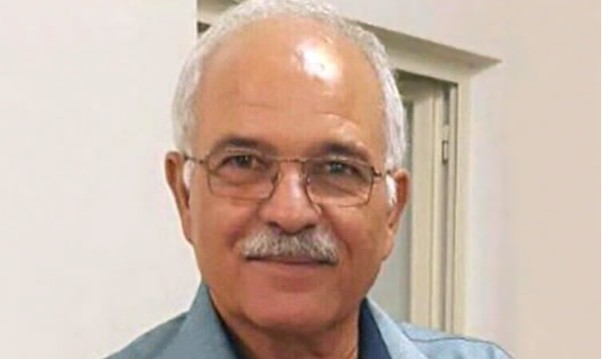
YAZD PROVINCE: On 27 September 2026, coinciding with the tenth anniversary of the murder of Mr. Farhang Amiri, a Bahá’í residing in Yazd, around 40 agents acting under a warrant issued by the Revolutionary Court raided the homes of members of his family and searched them until the early hours of the following morning. Four days later, agents also raided a farm belonging to the family.
Every year, on the anniversary of his murder, the Amiri family held a memorial gathering and invited relatives and acquaintances. This year, because of previous raids by agents on such gatherings, the family had asked relatives not to attend. When the agents arrived at 9 p.m., only immediate family members were present at the home for dinner.
The agents searched all three floors of the house, including the residence of Mrs. Mahnaz Foroudi, Mr. Amiri’s wife, and the home of his son, Mr. Payam Amiri. That same night, they also searched the home of his daughter, Mrs. Neda Amiri, and her husband, Mr. Maziar Mottahed, at a separate location.
Before the search began, at Mrs. Neda Amiri’s request, the agents showed the full warrant for the search of the belongings of Mr. Farhang Amiri’s wife and two daughters. The search continued from 9 p.m. until approximately 3 a.m. The masked male and female agents struck the floor to check beneath the ceramic tiles. They body-searched those present individually in a separate room.
The agents confiscated mobile phones, personal belongings and items associated with the Bahá’í Faith, and summoned two specialists to the premises to extract data from the phones. During the search, one of the children present cried, wanting the phone back. Mr. Mottahed refused to hand over his child’s iPad, saying that the agents could extract its data but that he would not surrender the device. After the data had been extracted, the children’s phones and laptops were returned.
That same night, Mrs. Foroudi’s condition became serious as a result of the psychological pressure caused by the agents’ presence and the search of the home. The agents initially claimed that she was feigning illness, but as her condition deteriorated, the family called the emergency services. The emergency doctor ordered her immediate transfer to hospital, and emergency personnel took her there. She was discharged from hospital after receiving treatment.
On 1 October 2026, agents also raided the Amiri family’s farm. After searching the farm, they confiscated mobile phones, including the phone belonging to the father of the family’s daughter-in-law, and a number of items on the premises. The agents also announced that the unauthorised buildings on the property would be demolished and served the family with a demolition order.
A few days later, agents telephoned the family and said that they would come to the property that night to carry out the demolition, asking the family to be present. At approximately midnight, a loader arrived and carried out demolition work on the neighbouring farm until 4 a.m. but did not damage the Amiri family’s buildings.
Mr. Farhang Amiri, a 63-year-old Bahá’í, was stabbed to death outside his home in Yazd on 26 September 2016. Following their arrest, the two accused in the case stated that his religious beliefs had been the motive for the murder. Before his murder, hateful content and statements against Bahá’ís had been disseminated in the media and from pulpits. During the proceedings, the accused expressed no remorse for their actions.
No information is available about the fate of the Amiri family’s confiscated belongings. Furthermore, the official reasons for these searches and the final status of the buildings belonging to the family have not been announced.
10. Current Prisoner Population Details
MULTIPLE PROVINCES: Based on available confirmed information as of 17 November 2026, the BIC has verified that 65 Bahá’ís are currently detained or imprisoned solely for their beliefs in multiple locations across Iran. Of these, 34 are women and 31 are men. They are held in standard prisons, intelligence detention centres, IRGC-run facilities, and, in some cases, unknown locations. Many have been exposed to physical and psychological abuse, including lengthy, abusive interrogations, prolonged solitary confinement, beatings, electric-shock torture, mock executions, forced confessions, and denial of access to essential medical treatment and medication.
In addition to the 65 individuals physically incarcerated, at least 20 others are currently serving sentences outside prison under electronic monitoring or temporarily on leave.
The detainees are located in Dowlatabad Prison in Isfahan, Vakilabad Prison in Mashhad, Hamadan Prison, Kachouei Prison in Karaj, Kerman Prison, Central Prison of Karaj, Evin and Fashafuyeh (Greater Tehran) Prisons in Tehran, Bukan Prison, Semnan Prison, Adelabad Prison in Shiraz, Dastgerd Prison in Isfahan, Yazd Prison, Qarchak Prison in Varamin, the Shahriar Detention Centre, and Zahedan Prison. A number of the detained individuals are being held in undisclosed locations, raising serious concerns regarding transparency, due process, and access to legal representation.
Women constitute the majority of those detained, and several detainees are held in facilities operated by the IRGC or intelligence services, indicating the security-related nature of these cases and their apparent connection solely to the detainees’ religious beliefs.